


Heavy-Duty Machine Frame
The heavy-duty machine frame and reinforced fabricated steel gantry allow for high acceleration and deceleration fiber laser cutting rates. The machine bed contains three downdraft zones; each zone has a pneumatically activated door that is CNC-controlled to focus the fume extraction under the cutting process.
The Value of Linc-Cut Systems
Linc-Cut systems can save you money compared to outsourcing parts and other CNC cutting systems that require more capital and post processing of parts.
The Linc-Cut was specifically designed with an emphasis on ease of setup and operation. Its user-friendly HMI helps remove the barriers to laser cutting common with traditional teach pendant interfaces.
Linc-Cut systems have reduced floor space requirements over standard “shuttle” exchange tables and offer compact power supplies that are integrated into the machine frame.
Online and on-site training options are offered for Linc-Cut systems. Online training modules cover key features and functions in detail. Alternatively, have expert technicians come to your facility for machine commissioning, operation and maintenance training.
The Linc-Cut system has a fully enclosed cell that is emission-light safe from the infrared light of the laser cutting process, and captures the particulate matter with a smaller, more effective air filtration system.
The Linc-Cut product family continues to grow. Customers can choose between the Linc-Cut 3015 drawer or 1530s shuttle systems. Multiple laser cutting machine options allow for a more personalized solution for different shop needs.
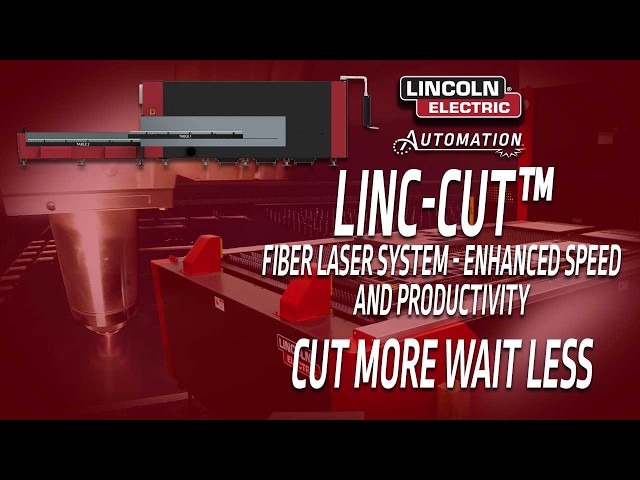
Meet the Linc-Cut Systems
Linc-Cut system cut speeds greatly exceed plasma cutting in gauge materials. When coupled with a sturdy machine with high acceleration and deceleration rates, the systems produce cuts with little to no secondary processing. The 12kW option is available for processing plate thicknesses, with notable cut speed improvements over a 6kW or 4kW system.
FAQs
Get the answers to frequently asked questions about the systems and their processes.
Fiber lasers are optimized for metals. Commonly cut materials include carbon/mild steel, stainless steel, aluminum, copper, brass, galvanized steel, and titanium. They are generally not ideal for non-metals like wood, acrylic, or glass because fiber wavelengths (~1.06 μm) are poorly absorbed by many organic/transparent materials.
The 12 kW Linc-Cut 1530S system can cut up to 1.5” carbon steel.
Fiber lasers typically offer higher cutting speeds on thin-to-medium metals, better efficiency (wall-plug), lower maintenance (no resonator mirrors/gases), and better performance on reflective metals. CO₂ can still be competitive on very thick plate or non-metals, but for most metal fabrication, fiber dominates.
Primary cost drivers include electricity, assist gas (nitrogen, oxygen, or air), consumables (nozzles, protective windows, lenses), routine maintenance/cleaning, and labor. Compared to CO₂ systems, fiber lasers usually have significantly lower energy consumption and fewer maintenance items, leading to lower cost per part.
Common choices:
- Nitrogen: Inert gas for clean, oxide-free edges that is preferred for stainless and aluminum.
- Oxygen: It promotes an exothermic reaction for faster mild steel cutting, but leaves an oxidized edge.
- Shop air: Cost-effective alternative (with a clean, dry, high-flow supply) that is good for many thin/medium applications with acceptable edge finish.
Typical tasks include cleaning/inspecting protective windows and lenses, checking and cleaning nozzles, aligning the cutting head, cleaning the table and removing slag, replacing filters, ensuring proper lubrication per OEM schedule, and keeping the chiller and dust collection systems within spec. Trained Lincoln Electric Automation service specialists are available to perform any system maintenance you would like. Request service below:
Match power to your thickest material, speed requirements, and throughput goals. General guidance: job shops cutting thin-to-medium gauge metals often select 3–6 kW; high-throughput or heavy-plate applications may justify 8–20 kW. Higher power increases speed on thicker materials but also increases capital cost and assist gas flow demands.
A standard (single) bed, such as with the Linc-Cut 3015 system, requires machine downtime for loading/unloading between cuts. An exchange or shuttle (dual pallet) table, such as with the Linc-Cut 1503S system, allows one table to be loaded while the other cuts, dramatically reducing idle time and boosting throughput, especially valuable in production environments.
Request pricing on the Linc-Cut fiber laser cutting systems below. Financing options are also available, so you can spread payments over time. Feel free to ask about current offers in your quote request.
Basic operation can be learned in 1–3 days. Mastery of nesting, parameter optimization, advanced maintenance, and troubleshooting typically takes 2–4 weeks of regular use. Structured training is included with every Linc-Cut fiber laser system purchase. A Lincoln Electric trainer will assist you with the operating requirements at your location when your new machine in installed. Additional training can be requested by email at support@torchmate.com.
One Phone Number. All of Automation.
Whether you need technical assistance, spare parts, training, preventative maintenance, or other services, we've got you covered. Regardless of the system or where you acquired it in the Lincoln Electric Automation world, please call us at +1 (866) LEA-0411.
Online Post-Purchase Service Request Form
Rather submit a service request online? No problem! Fill out our helpful service form at the link below. We understand the urgency of unplanned downtime, so we will reply to your inquiry as soon as possible.